Block Wall Cost in San Tan Valley, AZ
Real pricing for CMU block walls in San Tan Valley and Pinal County. Not national averages, not guesses, actual installed cost ranges for this specific market.
San Tan Valley Block Wall Pricing
Block wall costs in San Tan Valley are higher than national averages because of two factors specific to this area: caliche soil excavation adds to footing costs, and the extreme heat of Arizona summers adds logistics costs (early-morning concrete pours, cure-time limitations, summer crew scheduling). The prices below are based on actual contractor quotes for projects in San Tan Valley and the surrounding East Valley as of 2025.
| Wall Type | Height | Price Range | Notes |
|---|---|---|---|
| Standard CMU fence wall | 6 ft | $90 to $180 / lf | Most common residential wall in San Tan Valley |
| Standard CMU fence wall | 4 ft | $55 to $100 / lf | Side yard or low partition walls |
| Split-face block wall | 6 ft | $120 to $220 / lf | 25 to 40% premium over standard CMU |
| Cinder block (CMU) per sq ft | Any | $11.25 to $12.85 / sq ft | CMU install rate including labor and material |
| Stucco finish add-on | N/A | $4 to $8 / sq ft | Applied over CMU for Southwestern finish |
| Full perimeter (200 lf) | 6 ft | $12,000 to $25,000 | Typical residential backyard, standard CMU |
| Full perimeter (300 lf) | 6 ft | $20,000 to $40,000 | Larger lot; split-face or caliche site at high end |
What Drives Block Wall Cost in San Tan Valley
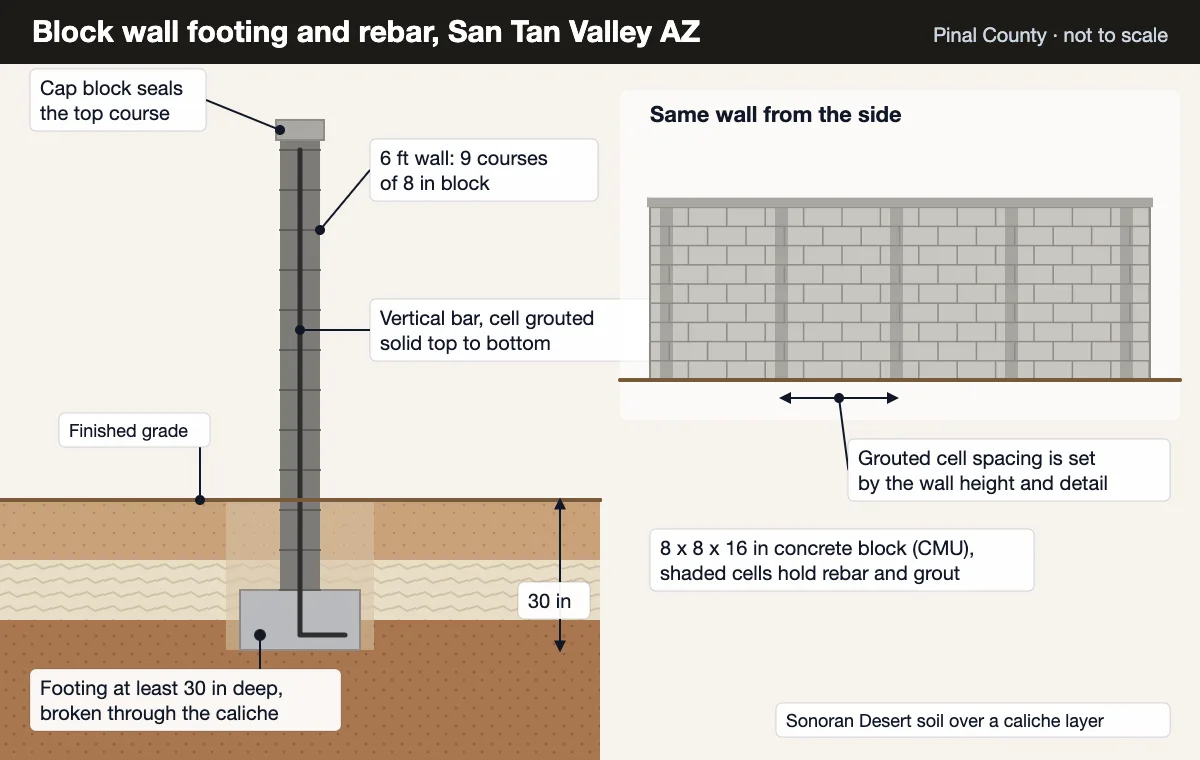
This is the biggest variable in San Tan Valley block wall pricing. Pinal County sits on Sonoran Desert soils with caliche, a calcium carbonate hardpan layer. Footings must break through caliche to reach stable native soil before pouring concrete, typically 30 inches minimum. Where caliche runs deep, excavation takes significantly more time and labor. Budget $3 to $8 per linear foot over base footing cost for caliche excavation. Your contractor should probe for caliche before finalizing a quote.
Taller walls cost more per linear foot because they require more CMU, more rebar, more grout fill, and a heavier footing. A 4-foot wall is significantly less expensive per linear foot than a 6-foot wall. Most San Tan Valley HOAs require 6-foot privacy walls for backyard perimeters. Side yard walls may be permitted at 5 feet depending on HOA rules.
Standard gray CMU is the most economical option. Split-face block costs 25 to 40 percent more and is required or strongly preferred by many San Tan Valley HOAs for its finished appearance. Slump block is a Southwestern style that some older subdivisions use. If you need to match an existing wall for a repair or addition, the block type is locked in and you pay the corresponding rate.
Adding a stucco finish coat over CMU adds $4 to $8 per square foot to the total project cost. Stucco is common in San Tan Valley subdivisions that require a uniform finished appearance on all wall surfaces. Some HOAs require it; others make it optional.
Short runs cost more per linear foot than long runs because setup and cleanup costs are spread over fewer feet. A 50-foot run often runs 15 to 20 percent more per linear foot than a 200-foot run with the same wall type. Properties with limited equipment access may also add cost for material handling.
Three Real San Tan Valley Budgets
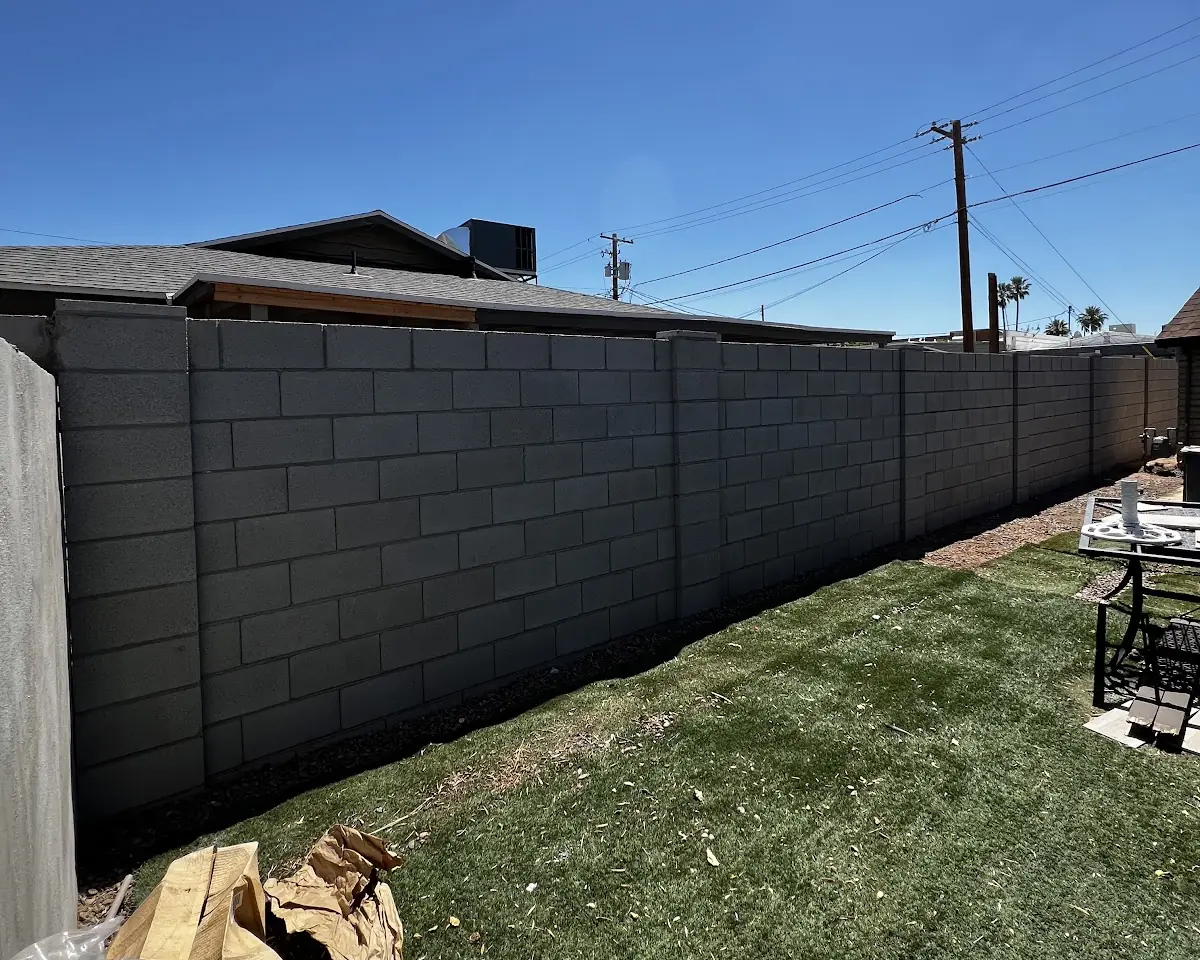
Recent project from our featured contractor
A finished backyard wall from our featured contractor's own job photos: a long run of gray block with pilasters along it, standing behind a fresh lawn.
In a Google review, Sara H. wrote: “Very reliable, quality work. I really liked working with [our contractor], he was excellent with customer service and replying/communication. Reasonable price and timely work.”
Per-linear-foot figures are useful for comparison and useless for budgeting, because the length of the run and the finish drive the total far more than the rate does. These are the three shapes most San Tan Valley homeowners actually end up buying.
A short run tying the house to the existing perimeter, usually with a gate opening. Per foot this is the most expensive wall you can buy, because mobilization, layout, and a concrete delivery all get spread over 40 feet instead of 200. If you are considering other masonry work in the next year or two, bundling it into one job is worth real money.
The standard San Tan Valley backyard. The low end is gray CMU on a lot with shallow caliche and clean equipment access. The high end is split-face block to an HOA specification, deep caliche requiring extra excavation, and a stucco coat on the visible face. Most jobs land in the middle, around $16,000 to $19,000.
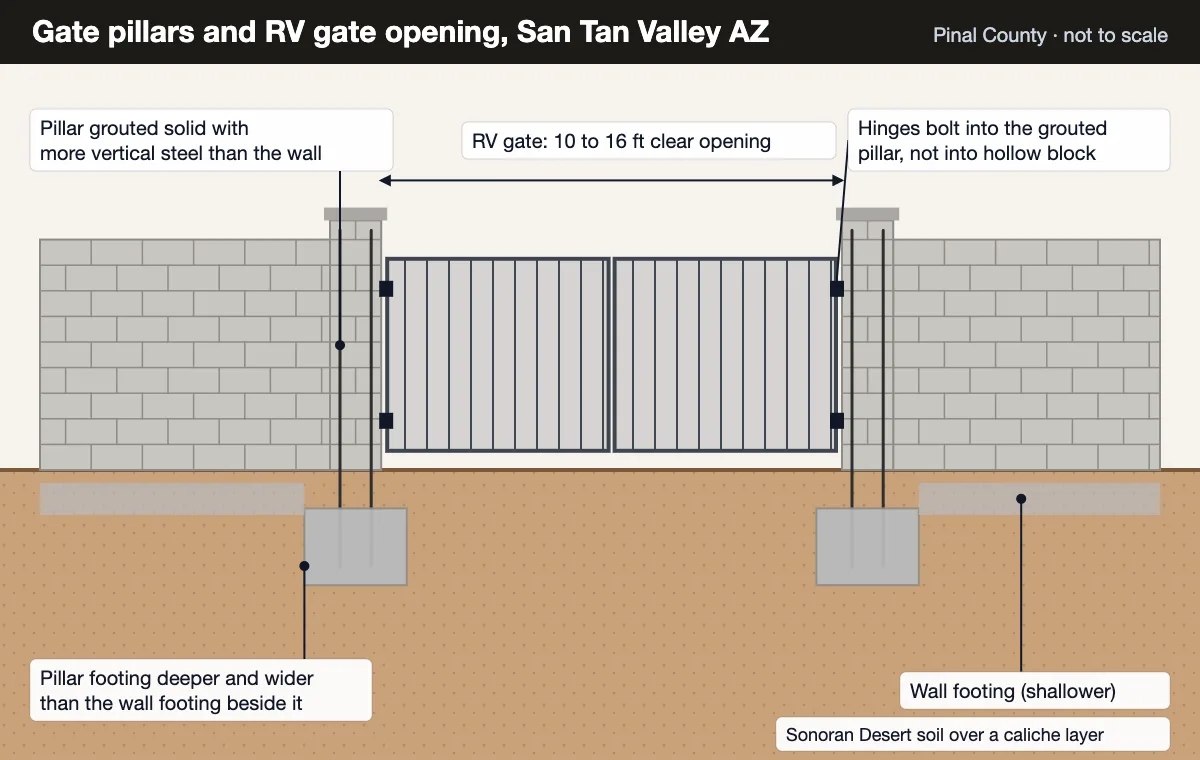
Three sides plus a return, a pair of grouted pillars carrying a 12 to 14 foot RV gate, and usually a stepped footing somewhere if the lot has any fall to it. The gate hardware and the pillar footings are a meaningful line item on their own. This is the common shape on the larger lots in Circle Cross Ranch and out toward Copper Basin.
Repair Pricing vs New Construction
Repair is priced by the fix, not by the foot, and the spread is wide. These are typical ranges in San Tan Valley.
| Repair | Typical San Tan Valley Range |
|---|---|
| Tuck-pointing deteriorated mortar joints | $5 to $15 / lf |
| Cap replacement along an existing run | $10 to $25 / lf |
| Cleaning and treating efflorescence | $3 to $8 / sq ft |
| Rebuild a single toppled or failed panel | $600 to $2,000 |
| Section rebuild from a new footing | $90 to $180 / lf, same as new build |
| Stucco or texture coat over an existing wall | $4 to $8 / sq ft per face |
The judgment call is when repair stops being the cheaper option. A useful rule of thumb: once more than roughly a third of a run shows genuine footing movement, rebuilding the whole thing usually costs less per foot than chasing it panel by panel, because setup and layout get spread across more feet. Below that, section repair wins comfortably. Details on diagnosing which situation you are in are on the block wall repair page.
What Is Not Included in a Block Wall Quote
Most disputes over a masonry invoice in Pinal County come from scope, not from rate. These are the items that are commonly excluded and are worth confirming in writing before you sign.
Property survey or pin location. If the pins are buried or missing, locating the line is a survey cost, not a masonry cost. On a shared line it is money well spent.
Removal and disposal of an existing wall. Demolition and haul-off is a separate line. Old block is heavy and the landfill charges by weight.
Permit fees and engineered plans. Only triggered over 7 feet, or over 4 feet on a retaining wall, but when triggered the engineering is a real cost.
HOA submittal fees. Some San Tan Valley associations charge an architectural review fee. That is between you and the association.
Utility relocation. Irrigation lines, low voltage lighting and drip systems crossing the trench line have to be moved. Anything crossing the line is worth flagging at the site walk.
Gates and hardware. Gate leaves, posts, hinges and latches are usually quoted separately from the masonry, including RV gates.
Landscaping restoration. Cleanup and spoil haul-off are normally part of the masonry quote. Replanting or re-laying rock along the trench line is normally the homeowner's scope.
Why San Tan Valley Prices Sit Above National Averages
National cost calculators will tell you a block wall runs $40 to $80 per linear foot. Those numbers are real somewhere. They are not real here, and quoting them back to a Pinal County contractor will not lower a bid. Three local factors account for the gap.
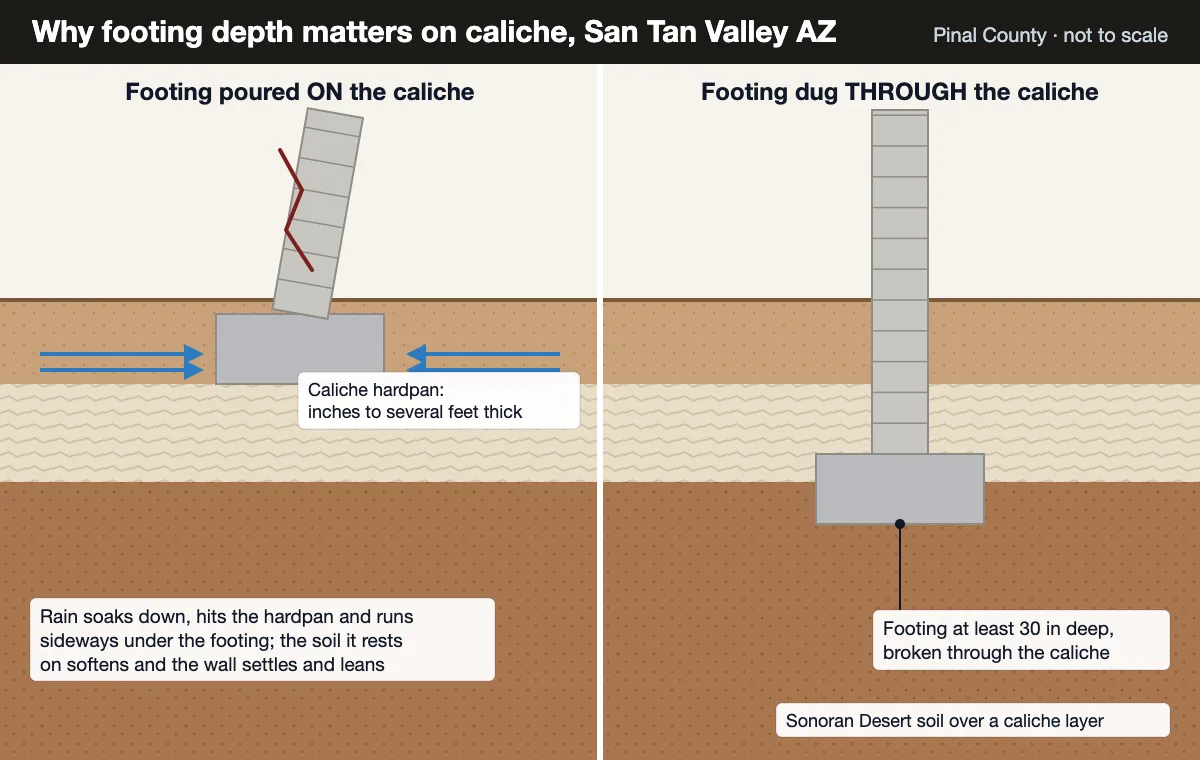
First, the footing. Almost nowhere else in the country requires breaking through a cemented calcium carbonate hardpan to reach stable soil. Caliche excavation adds machine time, occasionally a breaker, and always more labor per foot of trench. That is $3 to $8 per linear foot before a single block is laid.
Second, the heat. From May through September, concrete placement moves to early morning to avoid flash setting, which means shorter productive days and more of them. Add the monsoon window of June 15 to September 30, when an afternoon storm can flood an open trench and cost a day of re-excavation.
Third, the specification. Block walls here are structural elements carrying real wind load, not decorative garden walls. Continuous vertical rebar, grouted cells, and a proper cap are standard in this market and are a material and labor cost that cheaper regional averages simply do not include.
Common Pricing Questions
How much does a block wall cost per linear foot in San Tan Valley?
Does caliche soil add to the cost of a block wall?
Is it cheaper to repair a damaged wall or rebuild it?
Why do some quotes come in much lower than others?
Do contractors charge by the linear foot or by the square foot?
Is a taller wall proportionally more expensive?
Will my HOA or my neighbor pay part of the cost?
Does a block wall add value to a San Tan Valley home?
How much does an RV gate opening add?
Nearby Areas
A firm flat-rate price starts with a site walk and a caliche probe. Free estimate, no obligation.
Request a Free Estimate