Caliche Soil and Block Walls in Pinal County, AZ
Why block walls crack in San Tan Valley, what caliche actually is, how deep footings need to go, and what questions to ask any contractor before they start digging.
What Is Caliche?
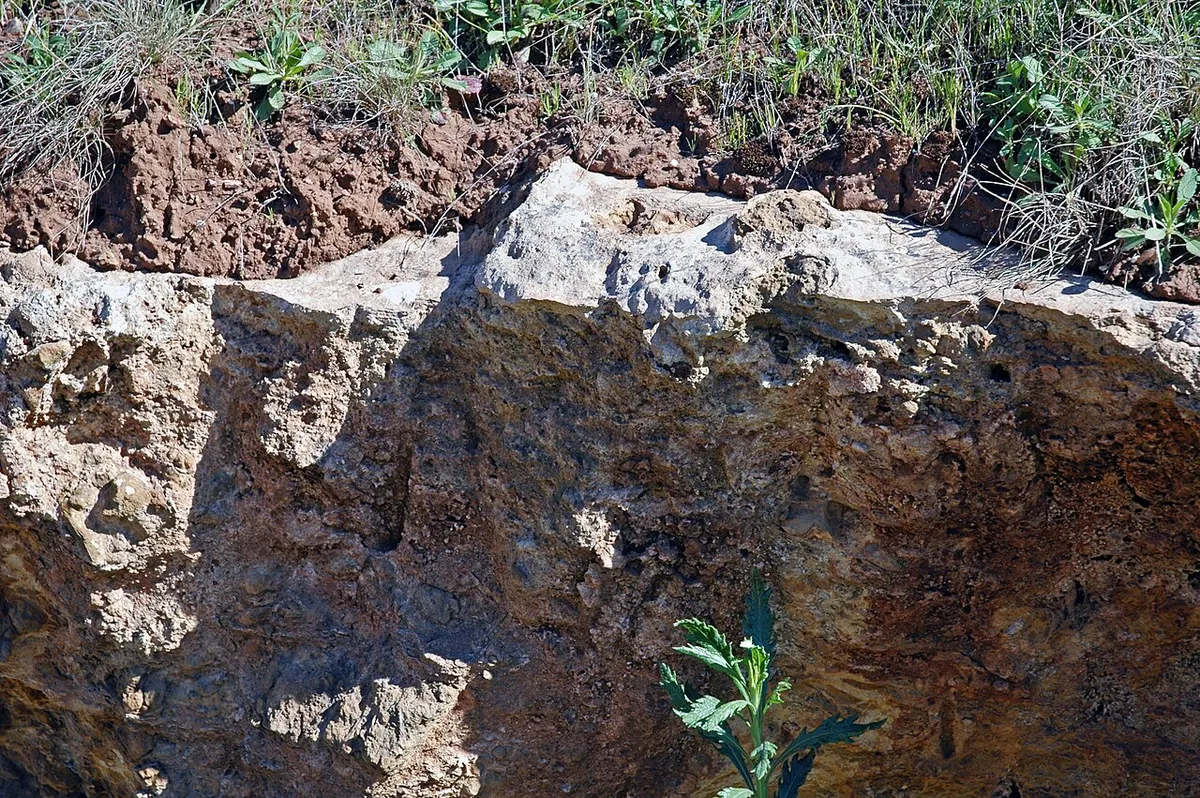
Caliche is a layer of calcium carbonate (CaCO3) that forms in the soil of arid and semi-arid regions over thousands of years. In the Sonoran Desert, caliche is nearly universal. Rain is scarce, so water evaporates before it can leach calcium carbonate out of the soil. Over time, that calcium carbonate accumulates at a certain depth and forms a hardpan layer that can range from a thin crust to several feet thick.
In San Tan Valley and Pinal County, caliche is present on most residential lots. The University of Arizona Cooperative Extension and the Arizona Desert Museum both document caliche as one of the defining soil characteristics of the Sonoran Desert region. The USDA Web Soil Survey confirms that Pinal County soils are dominated by calcic soil series, meaning calcium carbonate accumulation is a primary feature of the soil profile.
Caliche is not dangerous or toxic. But it creates a very specific construction challenge: it is hard like concrete when dry, it can be several feet thick, and, critically, it does not drain well. Water that hits the caliche layer spreads laterally rather than percolating downward.
Why Caliche Causes Block Walls to Crack
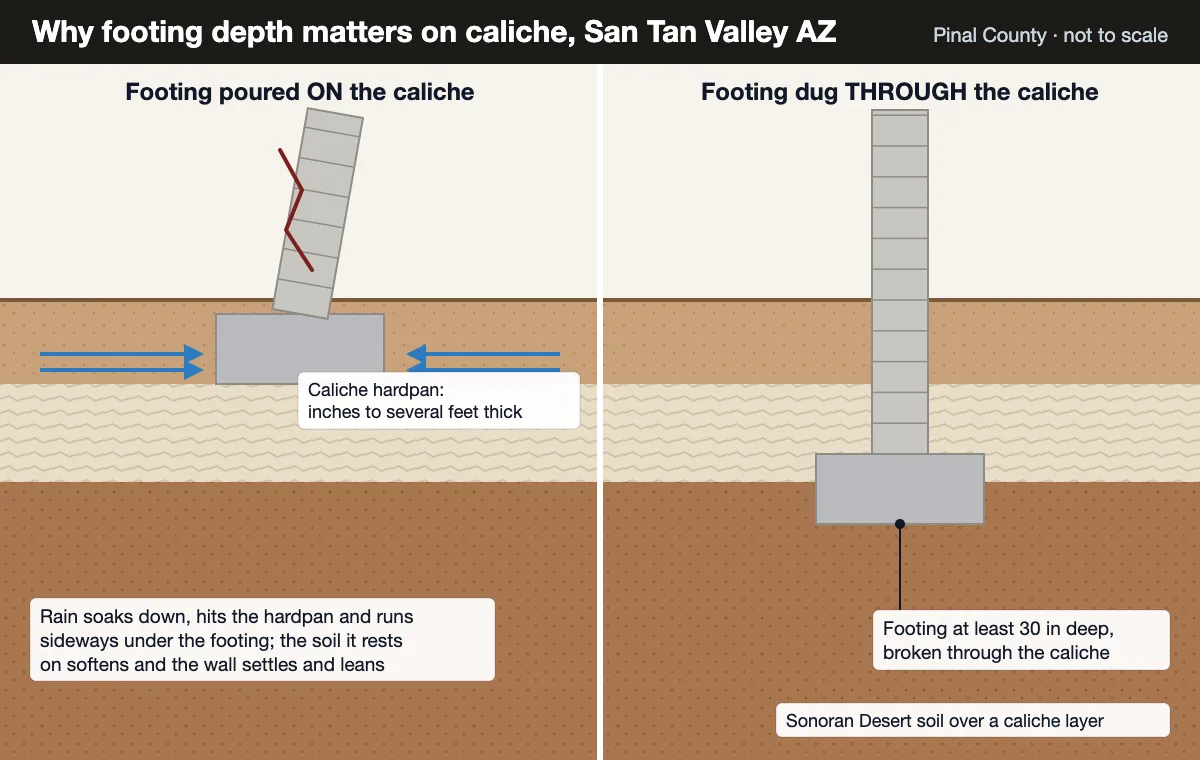
The failure mechanism is straightforward. A contractor digs a footing trench, hits caliche at 18 inches, stops digging, and pours concrete on top of the caliche layer. The footing looks solid when it cures. The wall goes up and looks fine. But the caliche layer underneath has a key property: it does not drain vertically. Rain and irrigation water collect above the caliche and spread laterally underground.
Over time, that moisture movement erodes fines from underneath the footing. The footing shifts. The wall above cracks. In San Tan Valley's case, the movement is accelerated by the expansive clay that coexists with caliche in some parts of the county, particularly in low-lying areas. Clay swells when wet during monsoon season and contracts in the dry months. That seasonal expansion and contraction creates lateral pressure that cracks mortar joints and, eventually, moves entire wall panels.
Thermal cycling compounds the problem. San Tan Valley temperatures range from near-freezing in winter to over 104 degrees in summer. The CMU block and mortar expand and contract with temperature. Well-set walls handle this fine. Walls on unstable footings develop cracks at mortar joints that widen with each thermal cycle.
The result is a wall that looks perfectly built when new and starts developing visible cracking within 3 to 7 years. By 10 years, walls set on caliche often have panels that are visibly leaning or cracked through multiple courses.
How Deep Do Footings Need to Go?
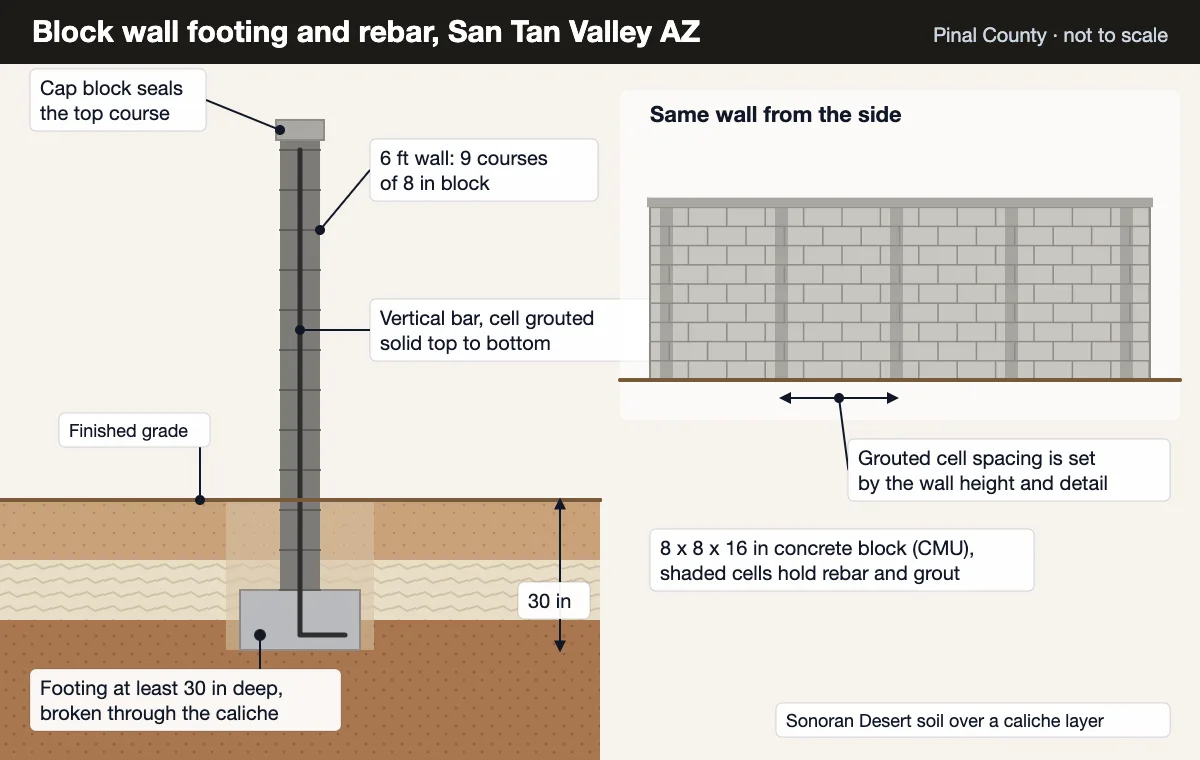
For block walls in San Tan Valley, footings should be set at a minimum of 30 inches below finished grade, with the actual depth determined by where the caliche layer ends and stable native soil begins. If caliche is present at 12 inches and runs to 24 inches, the footing should extend below 24 inches into stable native soil, meaning you dig to at least 24 or more inches regardless of what the code minimum says.
A contractor who quotes a flat 18-inch footing without probing for caliche depth is not accounting for your specific site. Caliche depth varies across Pinal County and even across a single lot. The only way to know is to probe or excavate and look.
When caliche is extremely thick, contractors sometimes break through it with a jackhammer or excavate around it rather than through it. The goal is always the same: get the concrete footing into native soil that drains and does not have a hardpan obstruction above it.
What to Ask a Contractor Before Hiring
How deep do you set your footings in San Tan Valley?
Do you probe for caliche before finalizing a quote?
Do your footings include drainage provisions?
What happens to the price if you hit deep caliche?
Related Guides and Services
Ask any bidder to probe for caliche depth and set footings below the hardpan. No shortcuts.
Get a Free Estimate