Block Wall Permit Requirements in Pinal County, AZ
When you need a permit, when you don't, what your HOA requires, and the exact Pinal County rules for block walls in San Tan Valley.
- San Tan Valley is unincorporated Pinal County, so Pinal County Building Safety rules apply, not a city code
- Fences and walls not over 7 feet from finished grade: no building permit (Bulletin 003)
- Walls over 7 feet: building permit plus AZ Registered Engineer plans (Bulletin 014)
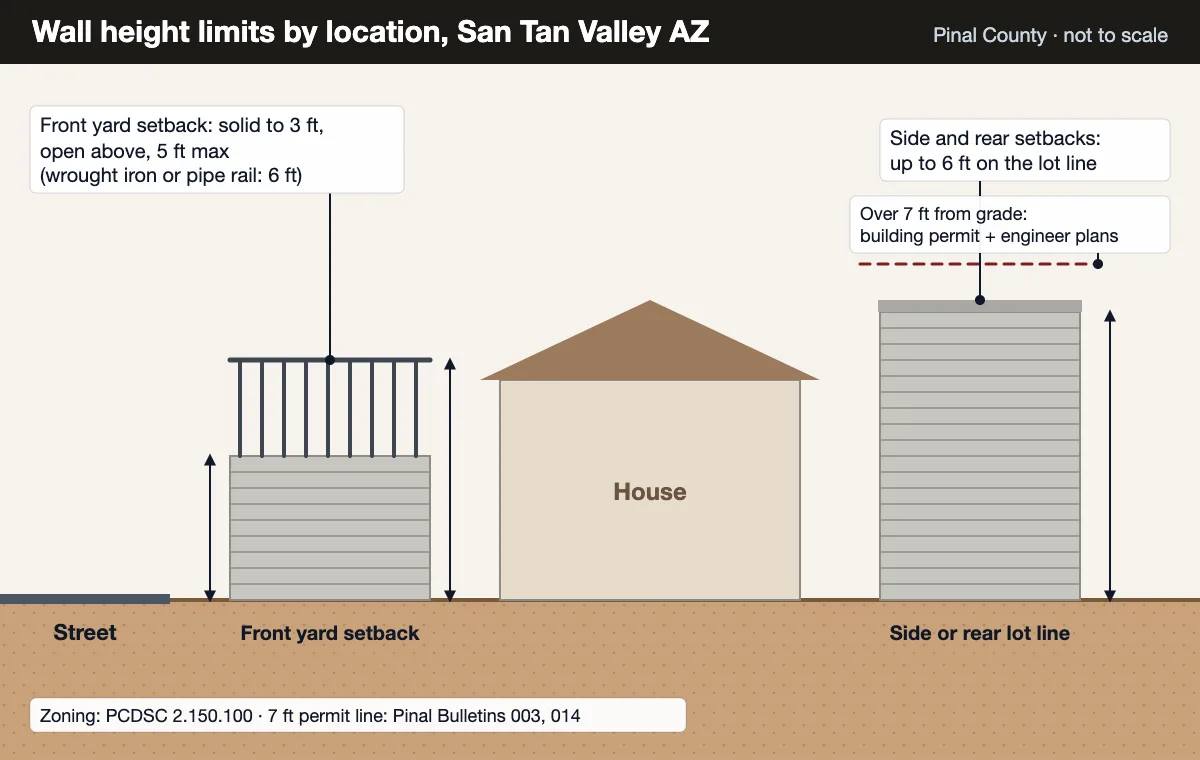
- Side and rear lot lines: walls 6 feet or less may sit on the line; taller walls must meet zoning setbacks (PCDSC 2.150.100)
- Front yard: 5 feet max, solid only to 3 feet, open fencing above; or 6 feet of wrought iron or pipe rail (PCDSC 2.150.100)
- Retaining walls over 4 feet from bottom of footing, or over 2 feet when holding a surcharge: permit + engineer plans
- Corner lots: nothing over 24 inches within the sight visibility triangle (PCDSC 2.150.080, 2.150.100)
- HOA CC&Rs may impose stricter rules than Pinal County code, always verify with your HOA
Pinal County Block Wall Rules in Detail
Two separate county rules set the numbers, and they are easy to blur. The building permit line comes from Pinal County Building Safety: fences and walls not over 7 feet are exempt. Where the wall may stand, and how solid it may be, comes from the zoning code, Pinal County Development Services Code (PCDSC) 2.150.100. A wall can be permit-free and still sit in the wrong place, so check both.
Side and Rear Yard Walls
For most San Tan Valley homeowners, the most common block wall project is a standard 6-foot privacy wall along the back or side property line. PCDSC 2.150.100(A)(3) says the setback requirements "shall not apply to fences or wall type fences of six feet or less in height that are being used as fences in side and rear setbacks," so a 6-foot wall can sit on the lot line. It is also under the 7-foot building permit line, so no permit is needed.
A wall taller than 6 feet loses that setback exemption, which means it has to meet the yard setbacks for your zoning district instead of sitting on the lot line. Many San Tan Valley subdivisions are zoned as planned area developments with their own setback conditions, so look up your parcel's zoning through the Pinal County Citizen Access portal or ask the Planning Division (520-866-6442) before going above 6 feet.
Walls Over 7 Feet
Pinal County Building Safety Bulletin 003 lists "Fences not over seven feet high, measured from finished grade" as exempt from a building permit, and adds that a single row of masonry cap on a masonry fence may go above the 7-foot limit. Bulletin 014 measures the 7 feet "from the side of the wall or fence having the lowest adjacent grade", which matters on a lot that steps down. Above that, the wall needs a building permit and plans prepared by an Arizona Registered Engineer.
Most residential block walls in San Tan Valley are 6 feet. HOAs typically specify 6-foot privacy walls for backyard perimeters. The over-7-foot rule applies mainly to commercial properties, subdivision perimeter walls along arterial roads, and specialized residential projects.
Front Yard Walls
A full-height solid block wall cannot run along the front yard setback, but a low solid wall can. Under PCDSC 2.150.100(A)(2), a fence in the front yard (the front and sides of the front setback area) is allowed when it is open fencing of 5 feet or less, fencing of 5 feet or less where the portion over 3 feet is open, or 6 feet of pipe rail or wrought iron, with gates no higher than 8 feet. In practice that means solid block up to 3 feet with view fence or iron above it, topping out at 5 feet.
Corner lots face an extra limit: nothing over 24 inches tall inside the sight visibility triangle (PCDSC 2.150.080 and 2.150.100). The code defines that triangle as 21 by 21 feet at a local to local street corner and 31 by 31 feet at a collector to local corner.
Retaining Walls
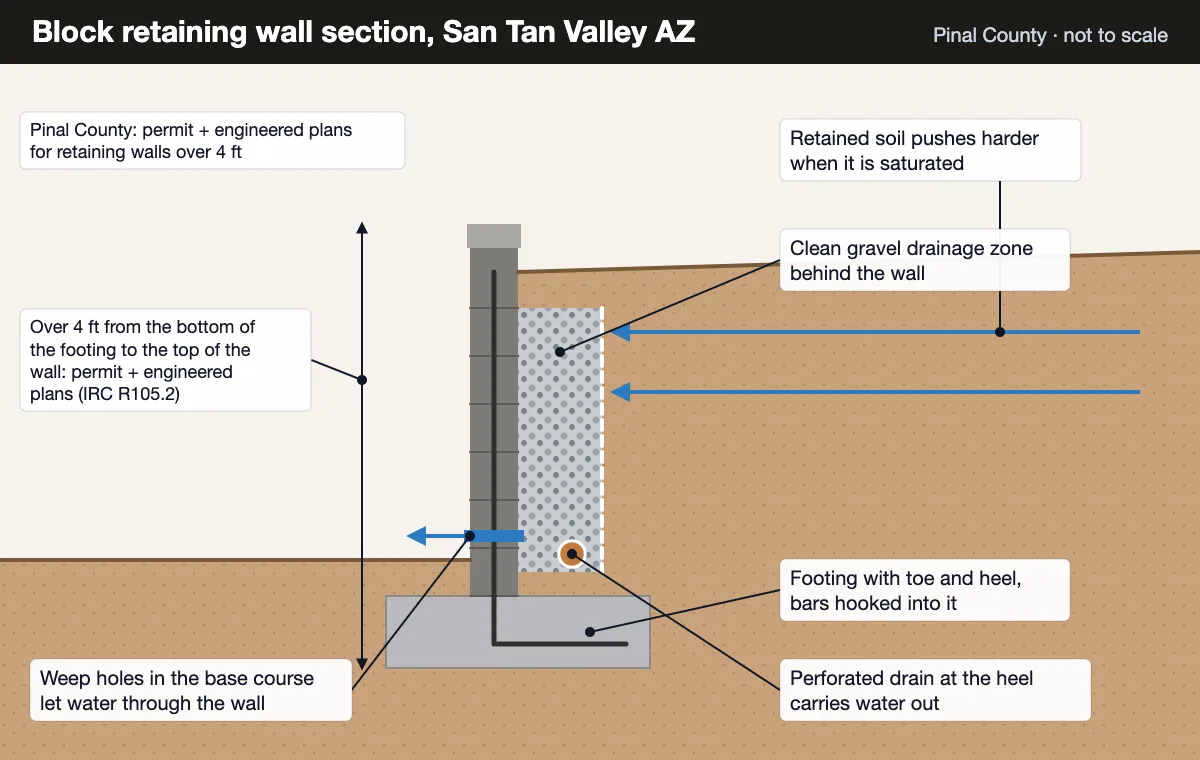
Retaining walls over 4 feet in total height, measured from the bottom of the footing to the top of the wall, require a Pinal County permit and engineer-stamped plans. Most landscape terracing walls under 4 feet do not require a permit, with two catches from Bulletins 003 and 014: a wall holding a surcharge (extra load above it, such as a driveway or a building) is only exempt up to 2 feet, and no other wall may be stacked on top of a permit-free retaining wall. If you are uncertain about your project's height relative to the footing depth, contact Pinal County Building Safety before starting.
HOA Requirements
Nearly all San Tan Valley subdivisions have active HOAs with CC&R requirements that are often stricter than Pinal County code. Before building any block wall in San Tan Valley, check your HOA's Declaration of Covenants, Conditions, and Restrictions for:
- Required block type (gray CMU, split-face, slump block)
- Required finish coat (stucco, paint, or bare block)
- Cap style and color requirements
- Maximum wall height (may be less than the county allowance)
- Setback from property line (may differ from county setback)
- Approval process and timeline before construction may start
Most San Tan Valley HOAs require written approval before starting wall construction. Approval processes typically take 2 to 4 weeks. Do not start construction before you have written HOA approval in hand, or you risk a stop-work order and possible removal at your expense.
Permit Questions Answered
Do I need a permit for a block wall in San Tan Valley AZ?
What is the maximum block wall height without a permit in Pinal County?
Do I need HOA approval for a block wall in San Tan Valley?
Who do I contact for Pinal County wall permits?
- Pinal County Building Safety: Fence and Wall Permit FAQ
- Pinal County Building Bulletin #14: Building Privacy Walls and Fences (PDF)
- Pinal County Building Bulletin #3: Permit Exemptions (PDF)
- Pinal County Development Services Code 2.150.100: Fences
- Pinal County Citizen Access Portal (online permit applications)
Related Guides and Services
Check the Pinal County rules and your HOA before the first trench. Free on-site estimates, no obligation.
Get a Free Estimate