Block Wall Repair in San Tan Valley, AZ
Cracked joints, leaning sections, and monsoon damage repaired throughout Pinal County, fixing the root cause, not just the surface.
Why Block Walls Fail in San Tan Valley
Block wall failures in Pinal County almost always trace back to one of three causes: footings set on caliche instead of native soil, inadequate footing depth, or lack of drainage behind the wall. Arizona's thermal cycling, from winter lows near 40 degrees to summer highs over 104 degrees, puts constant stress on mortar joints. Add monsoon season moisture and you have repeated expansion and contraction that eventually cracks even a well-built wall if the footing shifts underneath it.
Most block walls in older San Tan Valley subdivisions were built when the area was developing fast and labor was stretched thin. Short footings that never broke through caliche are common. Walls that look fine above grade are sitting on unstable ground below it. Surface patching doesn't fix a footing problem. Diagnosis has to come before the quote.
Common Block Wall Repairs
Tuck-pointing deteriorated joints and repointing affected sections. Mortar color is matched to the existing wall and sealed for Arizona UV.
Wall sections that have shifted off vertical indicate a footing or soil failure. The fix is removing the affected panel, resetting the footing to proper depth, and rebuilding to match the existing wall.
Wind-driven water and soil saturation during monsoon season can topple already-compromised panels. The rebuild starts from the footing up, with proper drainage weeps to prevent recurrence.
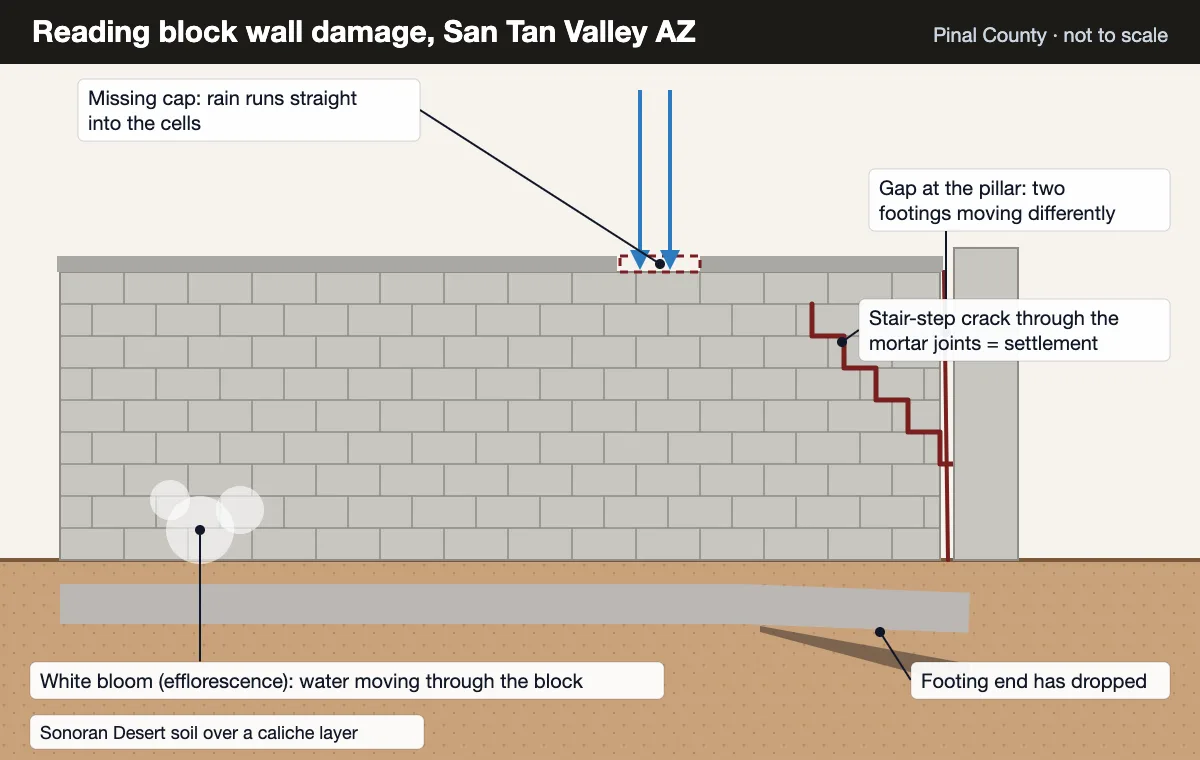
White mineral deposits on block faces indicate moisture moving through the wall. The fix treats the surface and the drainage behind the wall, to stop the source, not just the stain.
Cracked or missing cap block on top of the wall allows water to enter the CMU cells and accelerate deterioration. Cap replacement is one of the highest-value repairs on an aging wall.
Reading the Damage Before You Price the Repair
A block wall tells you what went wrong if you know what to look at. Diagnosing correctly is the difference between a $900 tuck-point and a $9,000 rebuild, and between a repair that holds and one that reopens after the next monsoon.
| What you see | Likely cause | Typical fix |
|---|---|---|
| Diagonal stair-step crack through the joints | Differential settlement, the footing has dropped at one end | Expose and reset the footing, rebuild the affected panel |
| Vertical crack repeating at regular intervals | Shrinkage and thermal movement with no control joint | Rout, seal and repoint, add a control joint on any rebuild |
| Wall out of plumb, leaning to the low side | Footing rotation, usually poured on the caliche shelf | Panel removal and a new footing to 30 in through the caliche |
| Horizontal crack partway up the wall | Lateral load, often soil or wind against an under-reinforced run | Assess reinforcement, rebuild with continuous verticals |
| Face of the block flaking and spalling | Moisture inside the unit plus UV and thermal cycling | Replace affected units, then coat or seal once dry |
| White powder blooming across the face | Efflorescence, water moving through the wall | Find the water path, fix it, then clean the face |
| Rust stains weeping from the block | Corroding rebar inside the cell, water is reaching the steel | Open the cell, treat or replace the steel, regrout |
| Cap loose, cracked, or missing | Age, impact, or an original job that skipped it | Cap replacement, one of the highest value repairs on an older wall |
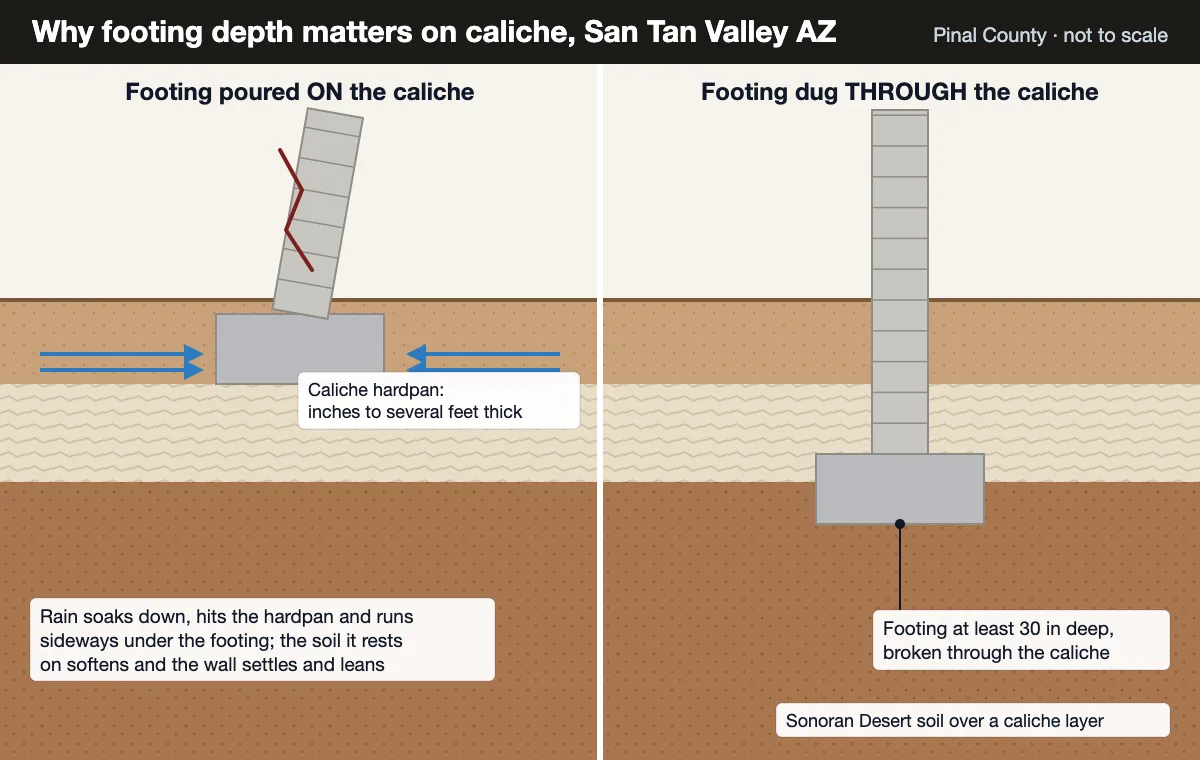
The most common pattern across San Tan Valley is the same story on a delay. A wall goes up on an 18 to 24 inch footing that stopped at the caliche shelf. It looks flawless for two or three years. Hairline verticals appear after the first serious monsoon. By year four or five the base of a section starts kicking outward. By year eight a panel is down. The caliche did not fail, it moved, which is what caliche does when water runs laterally across the top of it. The footing was sitting on a layer that was never stable to begin with. Full detail on that mechanism is in our Pinal County caliche soil guide.
How a Leaning Wall Gets Corrected
There is no honest way to push a leaning block wall back upright and leave it there. The block is rigid, the mortar has already cracked at the movement plane, and the footing under it is still sitting on whatever moved. Correction means going back to the ground.
Isolate the affected run. Cut back to sound wall at a clean vertical, so the repair terminates at a control point rather than mid course.
Remove and salvage. Block that is intact and matching gets cleaned and reused, which matters on older split-face and slump profiles that are no longer stocked locally.
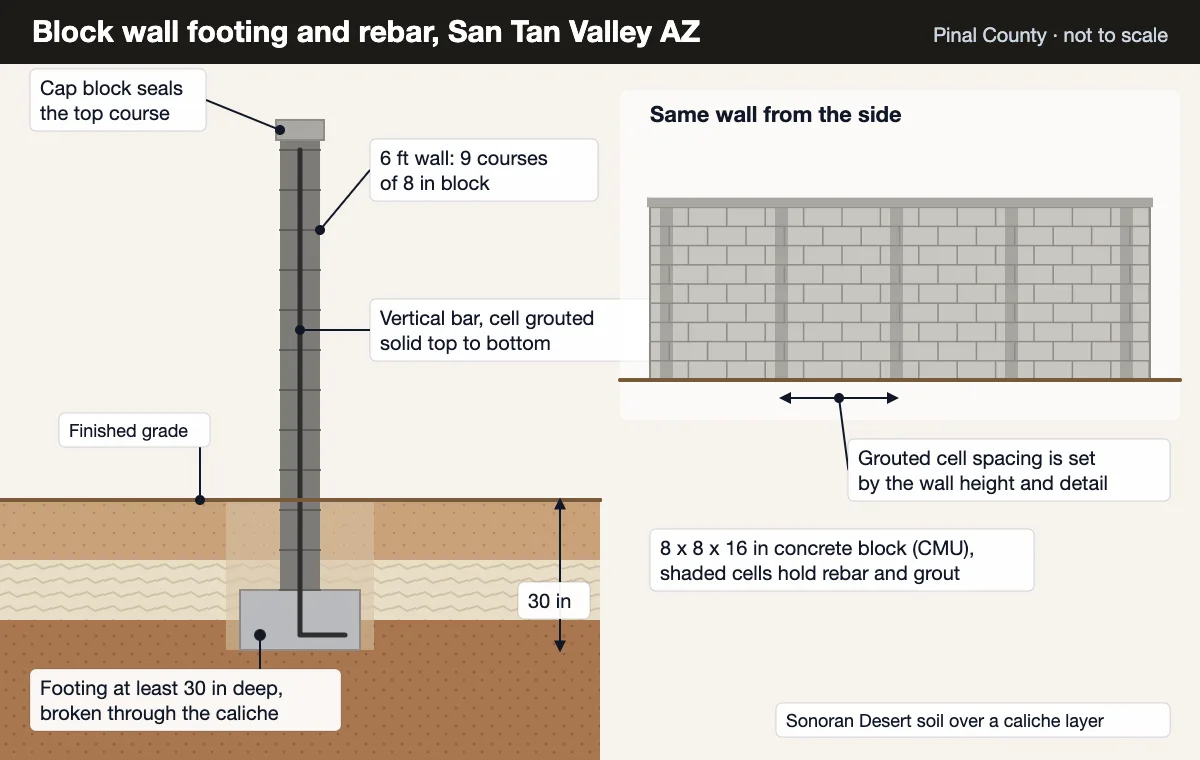
Excavate the failed footing. The old footing comes out. The new trench goes to 30 inches minimum, through the caliche shelf into stable native soil.
Pour and cure properly. New rebar cage tied and set, concrete placed, verticals positioned for the wall height, then a real cure window before any block is laid.
Rebuild and tie in. Courses laid to match the existing bond and joint, cells grouted, cap reset, and the finish blended so the repair does not read as a patch.
Fix the water. Whatever was feeding water under the footing gets addressed too: regrade, weep holes, irrigation pulled back off the base. Otherwise the new footing inherits the old problem.
Monsoon and Haboob Damage
Arizona's monsoon runs June 15 through September 30, and the outflow ahead of those storms has produced gusts in the 50 to 70 mph range across south-central Arizona. Those are the nights that put block walls on the ground across San Tan Valley. The walls that go down are almost never randomly chosen. They are the runs with hollow cells and no continuous vertical steel, the long unbroken spans with no pillar or return to brace them, and the walls with saturated soil banked against one face. If a section of yours came down in a storm, photograph it before anything gets moved, because the cause matters both for the repair spec and for any insurance claim. A storm rebuild should go back with continuous verticals and grouted cells, so the replacement section is stronger than what stood there before it.
HOA Color Matching
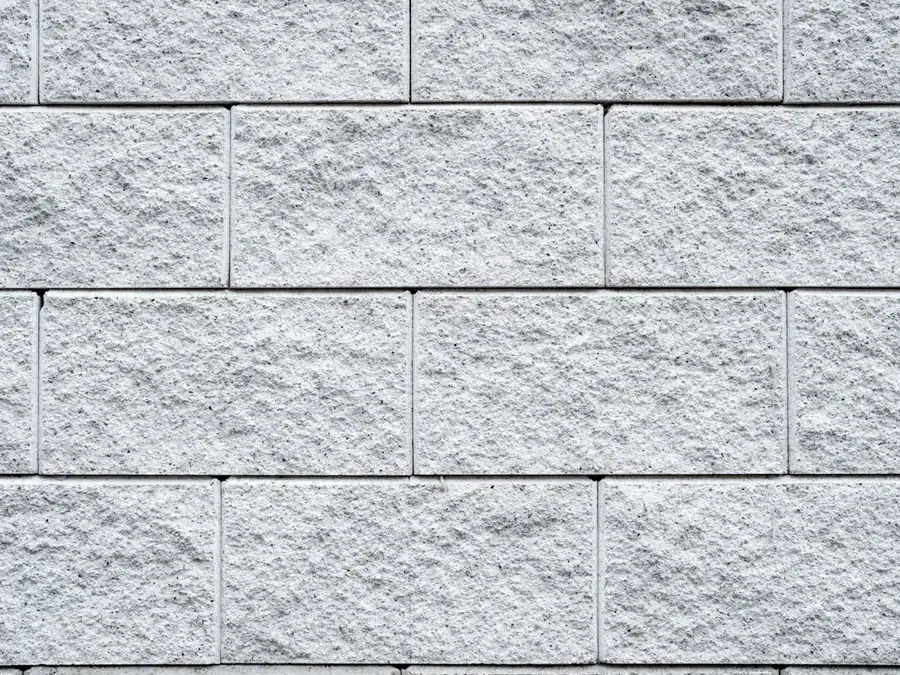
Most San Tan Valley HOAs require that repaired wall sections match the existing block color, texture, and cap profile. Common San Tan Valley block profiles are widely available, and HOA approval should come before any visible repair starts. If your HOA requires written approval before repair, photos and specifications of the existing wall support the application.
Matching is harder in some communities than others. Several Johnson Ranch villages specify a tan toned split-face profile, and a gray CMU patch there gets rejected even though it is structurally identical. Encanterra walls are largely stucco coated in a specified colour, which turns a masonry repair into a finish matching exercise as well. Where an exact block match is genuinely unavailable, the usual answer is a texture or stucco coat across the whole visible run, which unifies the wall and removes the patchwork look for good.
Keeping a Repaired Wall Standing
Block walls in the Sonoran Desert are low maintenance, not no maintenance. Once a year, ideally in May before the monsoon, walk the run and check four things. Is the cap intact and sealed at the joints? Are the mortar joints solid, or can you rake one out with a screwdriver? Does the grade still fall away from the base of the wall, or has landscaping been built up against it? Is any irrigation head spraying the block? Those four checks catch nearly every problem while it is still a hundred dollar fix rather than a four figure one, and they are why two walls built the same year on the same street can end up twenty years apart in condition.
Block Wall Repair FAQs
Can a cracked block wall be repaired without full replacement?
How much does block wall repair cost in San Tan Valley?
Can a repair match the existing block color and finish?
What causes block walls to lean in San Tan Valley?
How do I tell a cosmetic crack from a structural one?
Is it worth repairing, or should the wall be replaced?
My neighbor and I share the wall. Who pays for the repair?
Does homeowners insurance cover a block wall knocked down by a storm?
How do I stop efflorescence from coming back?
How long does a block wall repair take?
Nearby Areas
Helpful Resources
Block wall repair throughout San Tan Valley AZ and Pinal County. Fix the root cause, not the surface.
Get a Free Estimate