San Tan Block Walls
San Tan Valley, AZ · Masonry Contractors

Frequently Asked Questions

Common questions about our services, coverage area, and process. If you don't see your question, get in touch.

Do I need a permit for a block wall in San Tan Valley?

Usually not. San Tan Valley is unincorporated Pinal County, where Pinal County Building Safety exempts fences and walls not over 7 feet measured from finished grade. Walls over 7 feet tall, or retaining walls over 4 feet measured from the bottom of the footing, do require a permit and engineer-stamped plans. The county zoning code (PCDSC 2.150.100) sets where walls may go: a wall of 6 feet or less may sit on a side or rear lot line, and in the front yard setback fencing stops at 5 feet with anything above 3 feet open, so solid block there tops out at 3 feet. Always check your HOA CC&Rs as well, since most San Tan Valley subdivisions have their own stricter height, color, and material requirements.
How much does a block wall cost in San Tan Valley?

Standard CMU fence block walls in the San Tan Valley area run $55 to $125 per linear foot for basic gray block. A 6-foot tall privacy wall typically runs $90 to $180 per linear foot installed. A typical residential backyard perimeter of around 200 linear feet comes in at $12,000 to $25,000 depending on height, finish, and site conditions. Split-face or decorative block adds 25 to 40 percent over standard gray CMU. Caliche soil excavation adds roughly $3 to $8 per linear foot when footings have to break through hardpan. A firm flat-rate number needs a site walk, because caliche depth is the big unknown.

Why do block walls crack in Arizona?

Cracking is almost always a footing or soil issue. In San Tan Valley, caliche hardpan can cause footings to shift if water migrates laterally above it. Expansive clay in some areas swells during monsoon season and contracts in the dry months, creating movement that cracks mortar joints. Extreme thermal cycling, from winter lows near 40 degrees to summer highs over 104 degrees, also expands and contracts the CMU day after day. Properly set footings at 30 inches depth that break through caliche into stable native soil prevent most cracking.

How deep do block wall footings need to be in San Tan Valley?

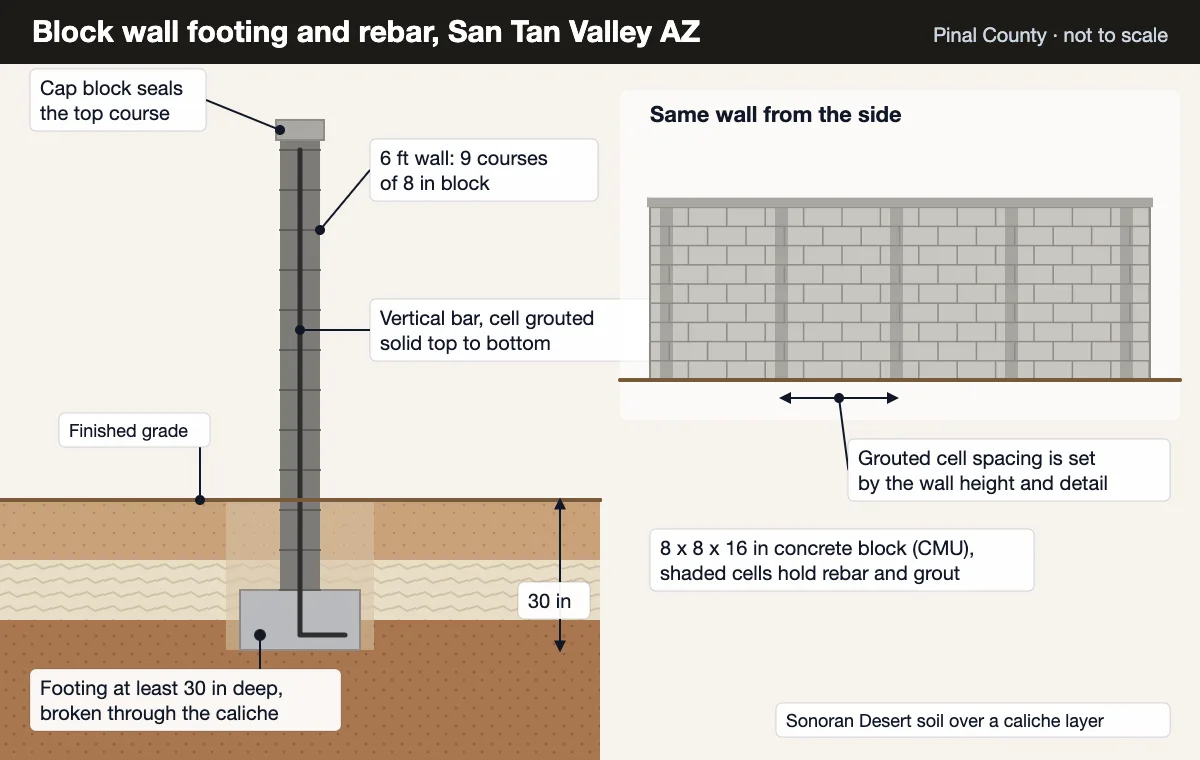
Footings for block walls in San Tan Valley typically need to go 30 inches deep to reach stable soil below the caliche layer. Caliche, a calcium carbonate hardpan common throughout Pinal County, must be broken through entirely before pouring concrete. Footings poured on top of caliche can crack as water migrates beneath. Arizona has effectively no frost line to design against, so depth here is driven by soil stability rather than freeze protection. Depth varies by property, since caliche layers range from a few inches to several feet in this area.

What is the difference between standard CMU and split-face block?

Standard CMU, or concrete masonry unit, has a smooth gray surface and is the most common and affordable block wall material. Split-face block is split after curing to expose the aggregate, giving a textured, more finished look that is popular in San Tan Valley subdivisions for both perimeter walls and entry features. Split-face costs 25 to 40 percent more than standard gray CMU. Both are durable in Arizona's climate and accepted by most HOAs in the area, though if you are matching an existing wall the choice is already made for you.

Are cinder block and concrete block the same thing?

Not quite, and the difference matters when you are pricing a wall. Modern block walls in San Tan Valley are built from concrete masonry units, made with sand and gravel aggregate and structurally rated. True cinder block, made with coal cinder aggregate, is lighter, weaker, and effectively obsolete in new residential construction here. Homeowners and contractors both use the terms interchangeably in conversation, so when someone quotes you a cinder block fence in Pinal County they almost certainly mean standard CMU.

Block wall section showing a vertical rebar in a grouted CMU cell running down into a footing 30 inches deep through caliche
Grouted cells and footing depth, the two answers around this picture: only the cells holding vertical bars are filled solid, and the footing goes at least 30 inches down, through the caliche. Our own diagram, not to scale.

Are the block cells filled with concrete?

Some of them, not all of them. On a typical 6-foot residential wall the vertical cells that contain rebar are filled solid with grout and the rest are left hollow. Those grouted cells plus the rebar are what tie the wall into the footing and let it resist wind load. A wall with no grouted cells is stacked block held together by face mortar, and that is the kind of wall that comes down in a monsoon outflow. Ask any contractor what the vertical spacing is on their grouted cells before you sign.

How long does it take to build a block wall in San Tan Valley?

A standard residential perimeter wall of 100 to 150 linear feet typically takes 3 to 5 business days from start to finish. Larger projects of 300 or more linear feet can take 1 to 2 weeks. Timeline depends on wall height, site access, and whether caliche excavation is needed for footings. Summer heat above 100 degrees limits concrete pour windows to early morning hours, which can add a day or two to larger projects. Add 2 to 4 weeks on the front end if your HOA requires architectural approval before work starts.

Who handles the HOA architectural submittal?

The packet is built from a written scope with block type, dimensions, cap profile, and finish specification, plus photos of the existing wall where a repair has to match it. The homeowner files the submittal itself, because most San Tan Valley HOAs will only accept it from the owner of record. Approval typically runs 2 to 4 weeks, so start it before you want a crew on site rather than after.

Can a damaged block wall be repaired without tearing the whole thing down?

Usually yes. Cracked mortar joints, spalled faces, a failed cap, and even a single damaged panel can all be addressed without touching the rest of the run. The dividing line is whether the footing under the damaged section is still sound. If the wall is leaning, or a section has moved off vertical, the footing has failed, and patching the block above it is cosmetic work on a structural problem. The footing gets diagnosed first and the repair quoted second.

Does the monsoon actually damage block walls?

It is the main seasonal stressor here. Arizona's monsoon officially runs June 15 through September 30, and the outflow winds ahead of those storms have produced gusts in the 50 to 70 mph range across south-central Arizona. A properly grouted and reinforced wall handles that. A wall with hollow cells, no rebar continuity down to the footing, or saturated soil piled against one face is the one that ends up flat in the yard. The second monsoon effect is slower: water pooling against the base of a wall with no drainage path undermines the footing over several seasons.

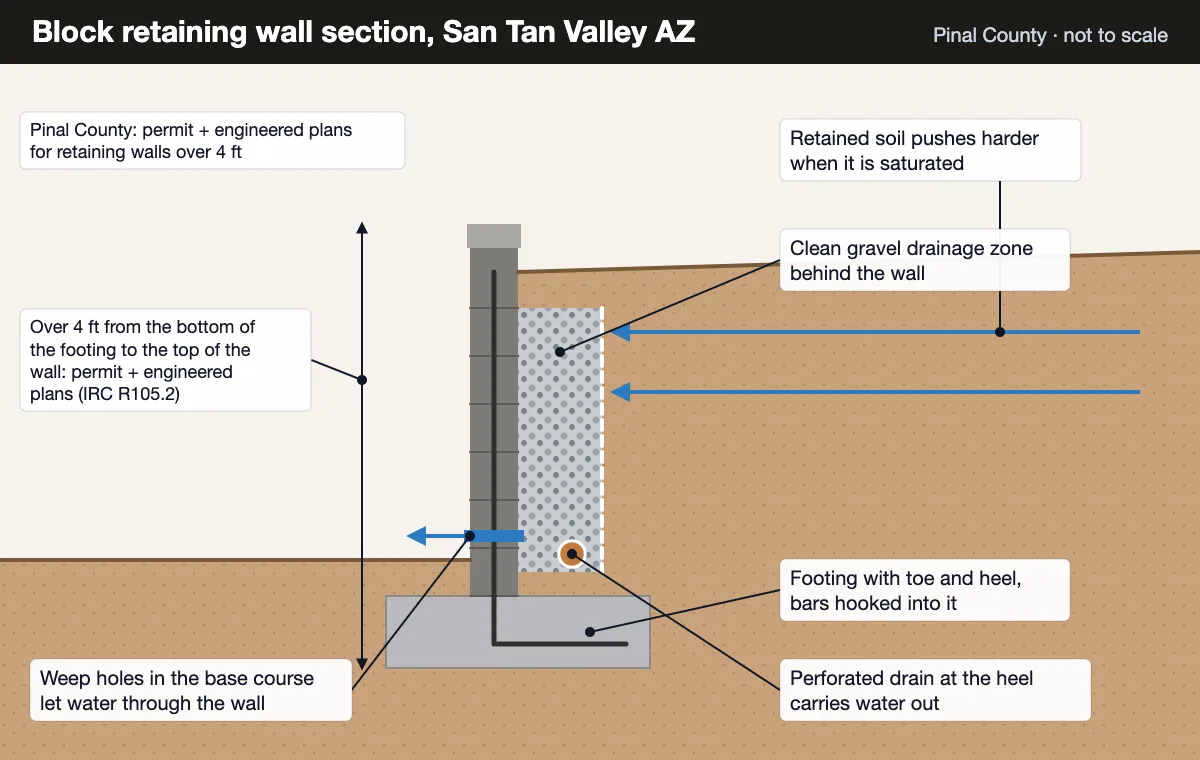
Retaining wall section with a gravel drainage zone, perforated drain at the heel and weep holes through the base course
Drainage behind a wall that holds soil: clean gravel against the block, a perforated drain at the heel and weep holes through the base course. Our own diagram, not to scale.

Do I need drainage behind my wall?

If the wall retains any soil, yes. Weep holes at the base course and a gravel drainage zone behind the wall give water somewhere to go instead of building hydrostatic pressure against the block. Even on a straight fence wall, the grade should fall away from the base rather than trapping runoff against it. On lots in San Tan Heights and Copper Basin where there is real grade change, drainage design is the difference between a retaining wall and a future repair bill.

Can you paint or stucco an existing block wall?

Yes, and it is one of the higher value cosmetic upgrades on an older wall. A texture or stucco coat over CMU hides mismatched repairs, unifies a wall that has been patched by three different people over twenty years, and adds a layer of protection against UV and wind driven rain. Budget roughly $4 to $8 per square foot per face. The one caution is that a coated wall needs its cap and joints sound first, because coating over an active moisture path traps the water inside the block instead of stopping it.

Should I use a block wall or a wood fence in San Tan Valley?

Block, in practice. Sun exposure and termites are hard on wood in the Sonoran Desert, and most San Tan Valley subdivisions specify masonry perimeter walls in their CC&Rs anyway. Block costs more up front and considerably less over a twenty year horizon, and it is what a buyer expects to see when the house eventually goes back on the market out here.

What license should a block wall contractor in Arizona hold?

Masonry work in Arizona falls under Registrar of Contractors classification 31: R-31 for residential, C-31 for commercial, and CR-31 for the dual license covering both. Concrete work sits under classification 9. Ask for the ROC number, then look it up rather than taking the number on a truck door at face value. Also confirm the contractor carries liability insurance and that the quote states footing depth in writing.

Do you work outside San Tan Valley?

Yes. Our core market is San Tan Valley and the surrounding unincorporated Pinal County corridor along Hunt Highway, Gantzel Road, Combs Road, and Bella Vista Road, and coverage extends to Apache Junction, Gold Canyon, Florence, and Coolidge. The soil profile across most of that footprint is the same Sonoran Desert caliche, so the construction standard does not change from one town to the next.

Call Now(480) 500-7823Free Quote